Journal de Ciencias Sociales Año 14 Nº 27
ISSN 2362-194X
Mapping of Research on the Well-being of Older Adults in Latin America
Luiza Klein Magri1
São Camilo University
Luciano Esposito Sewaybricker2
University of São Paulo
Scientific article
Material originally authorized for its first publication in the Journal de Ciencias Sociales, Academic Journal of the Faculty of Social Sciences of the Universidad de Palermo.
Receipt: 2026-06-30
Acceptance: 2026-10-24
Abstract: In light of the rapid population aging observed in Latin America, the study of well-being in old age becomes increasingly important and may be regarded as a priority for further investigation in the fields of scientific and social research. In this quantitative and cross-sectional article, we explore this issue through a systematic mapping, using the PRISMA 2020 protocol, by means of searches in the SciELO and LILACS, with the aim of analyzing the scientific output on the well-being of older adults in Latin American countries between 2020 and 2025. From the final collected sample of 179 articles, it was possible to subject them to a detailed analysis of methodological, geographical, and conceptual variables. The results indicated a predominance of quantitative articles (69.3%) with a cross-sectional temporal scope (80.4%), as well as a greater concentration of material published in Brazil (62.6%). The theme of well-being, in turn, proved to be peripheral in its presence (83.8% of publications), appearing primarily within health and medical fields and being commonly associated with the absence of disease. The study concludes by highlighting the need to expand research on the subject, also aiming at a deeper examination of well-being beyond biological characteristics, as an essential resource for aging.
Keywords: well-being; aging; older adults; Latin America.
Mapeo de investigaciones sobre el bienestar de adultos mayores en América Latina
Resumen: Ante el rápido envejecimiento poblacional evidenciado en América Latina, el estudio sobre el bienestar en la vejez se vuelve importante y puede ser entendido como prioritario para ser profundizado en los campos de la investigación científica y social. En este artículo, cuantitativo y transversal, exploramos esta cuestión a partir de un mapeo sistemático de la literatura, utilizando el protocolo PRISMA 2020, mediante búsquedas en las bases de datos SciELO y LILACS, con el objetivo de analizar la producción científica sobre el bienestar de las personas mayores en países latinoamericanos en el período comprendido entre los años 2020 y 2025. A partir de la muestra final recopilada, de 179 artículos, fue posible someterlos a un análisis detallado de variables metodológicas, geográficas y conceptuales. Los resultados indicaron una predominancia de artículos cuantitativos (69,3%) con un corte temporal transversal (80,4%), además de una mayor concentración de material publicado en Brasil (62,6%). El tema del bienestar, a su vez, tendió a manifestarse de forma predominantemente periférica (83,8% de las publicaciones), apareciendo con frecuencia vinculado a marcos de salud y la medicina, y siendo comúnmente asociado a la ausencia de enfermedad. Se concluye destacando la necesidad de ampliar las investigaciones sobre el tema, buscando también profundizar en el estudio del bienestar más allá de las características biológicas, como recurso esencial para el envejecimiento.
Palabras clave: bienestar; envejecimiento; adultos mayores; América Latina.
Introduction
Well-being is one of the central themes of contemporary social sciences. Its study encompasses everything from the emotional and hedonic dimensions of human experience (related to pleasure, positive affect, and life satisfaction) to broader aspects connected to personal flourishing, self-actualization, and the positive functioning of the individual (Alexandrova, 2017). Although frequently associated with the concept of happiness, with which it shares philosophical roots and conceptual overlaps (Lyubomirsky & Layous, 2013), well-being has its own scope: it articulates objective life conditions with subjective evaluations, involves multiple dimensions (such as affective, cognitive, social, and spiritual), and manifests in distinct ways across different stages of life.
It is precisely in this variation across life stages that well-being in old age takes on particular relevance. Old age represents not only the final stage of aging, but also a period marked by profound reconfigurations in the biological, psychological, social, and functional conditions of the individual. Schneider and Irigaray (2008) emphasize that aging is multifactorial and complex, influenced by biological, physiological, environmental, psychological, behavioral, and social aspects, and varies individually and/or collectively depending on gender, social class, culture, and health patterns. As Neri (2001) observes, aging begins at birth and occurs progressively, so that old age is the accumulated result of a long subjective process, unique to each individual. This complexity makes old age a privileged subject of study for understanding how well-being is shaped under specific life conditions. According to the World Health Organization (WHO, 2002), older people are considered to be those aged 60 or over in developing countries and 65 or over in developed countries. Even so, chronological age alone is not sufficient to understand the experience of aging; it is necessary to consider the lived context, choices made throughout life, and the functional capacity of the individual.
The demographic context of Latin America makes this investigation even more relevant. Countries in the region are undergoing an accelerated demographic transition, characterized by increasing life expectancy, falling fertility rates, and declining mortality. The result is significant population aging: according to Aranco et al. (2022): "Latin America and the Caribbean constitute the fastest-aging region in the world" (p. 11). This transformation is visible in the population pyramids published by CEPALSTAT (2022, as cited in Petrus & Pereira Júnior, 2023): while in 1990 the base of the pyramids was significantly wider than the top (that is, there were more births than people aging), by 2015 a more uniform distribution across age groups is already observed, reflecting greater longevity and the consequent growth of the older population. Demographic projections for the coming decades reinforce this trend (Mrejen et al., 2023), making the study of well-being in old age a growing priority for the social sciences in the region.
In light of this scenario, the present study presents the results of a systematic mapping of the scientific literature on well-being and aging produced in Latin America. The overall objective was to map and analyze how the topic has been researched in the region. The specific objectives were: to identify gaps and trends in research on well-being among the older population; to recognize particularities of Latin American scientific output on the topic; and to suggest opportunities for the field. From this analysis, the aim was to contribute to a more precise understanding of the state of the art and to indicate directions for research that can account for a population aging within a singular social, cultural, and economic context.
1. Literature Review
1.1. The Conceptual Complexity of Well-being: Philosophical and Psychological Considerations
Every empirical study on happiness or well-being begins with a choice that often goes unnoticed: how to measure its object. Is the respondent asked how satisfied they are with life? Is the frequency of their positive and negative effects measured? Is the extent to which they perceive meaning and purpose in their activities evaluated? Each of these options produces different numbers, ranks populations in different ways, and supports distinct conclusions, although all commonly circulate under the same generic label of "happiness" or "well-being." Before mapping what the Latin American literature has investigated on well-being and aging, it is therefore worth clarifying why this apparently technical question of instrument choice is, at bottom, a conceptual question.
In psychology, these measurement choices are organized around three major families of approaches (Alexandrova, 2017). The first, sometimes called hedonic, identifies happiness with the predominance of positive over negative affects and is typically operationalized through self-report instruments, such as the Positive and Negative Affect Schedule (PANAS; Watson et al., 1988). The second, centered on life satisfaction, shifts the focus from feeling to evaluating: what matters is the judgment that a person makes of their own life, as a whole or in relation to a specific domain, captured through direct questions such as "How satisfied are you with your life as a whole?" The third, termed eudaimonic or flourishing, refuses to reduce the good life to affective states or satisfaction judgments, and incorporates dimensions such as meaning, purpose, and fulfillment, present in Ryff’s (1989) psychological well-being model and in Ryan and Deci’s (2000) Self-Determination Theory.
The relationship among these three families is itself a matter of dispute. For Diener (1984), one of the most influential authors in the field, the first two are complementary and together sufficient to evaluate well-being, as they combine an affective and a cognitive component of life. Eudaimonic approaches challenge precisely this point: for their proponents, affect and satisfaction miss what is most decisive in a good life and need to be supplemented or even replaced by measures of meaning and purpose. Added to this is a persistent terminological confusion. Although all three approaches are equally subjective in terms of method (since all depend on the person’s own report), the expression "subjective well-being," formalized by Diener to designate the sum of affect and satisfaction, became generalized in part of the literature as a simple synonym for "self-reported measure," as opposed to "objective" indicators such as income or employment. The result is that the same term has come to designate different things depending on the discipline and the author, which complicates comparisons across studies.
These psychological distinctions, in turn, have roots in older philosophical disagreements about what constitutes a good life. A classic organization of these positions, following Parfit (1984), distinguishes three major groups of theories: objective list theories, for which the good life consists in the presence of certain goods (such as friendship or knowledge), regardless of whether the person desires them or derives pleasure from them; hedonistic theories, which make the quality of life dependent on the balance between pleasant and unpleasant experiences; and desire satisfaction theories, which ground that quality in the fulfillment of the agent’s own preferences. It is not difficult to recognize the kinship with the three psychological families described above: philosophical hedonism is close to the hedonic approach, and objective list theories are close to flourishing. The translation, however, is never perfect. The status of life satisfaction theories, so central in contemporary well-being science, remains open (at times treated as a variant of desire theories and at times claimed as a fourth independent tradition; Sewaybricker & Massola, 2023). Ultimately, as Alexandrova (2017) summarizes, well-being can be understood as a "synthesis value of the goods that matter to the agent for reasons that are not moral, aesthetic, or political" (p. 153), a deliberately broad formulation precisely because the content of those goods is what is in dispute.
It is not this article’s place to adjudicate these disputes, nor to exhaustively survey the many traditions in the field (McMahon, 2006). What matters is to retain the methodological lesson that follows from them: measuring well-being is never a neutral operation. Every scale, every questionnaire, every instrument begins from some answer, even if implicit, to the question of what makes a life good. Whoever chooses to measure positive affect is betting, even without declaring it, on one conception; whoever chooses to ask about purpose and fulfillment is betting on another. For this reason, disagreements about how to measure well-being are rarely exhausted at the technical level: beneath them there is usually a deeper disagreement about what, after all, is being measured. This relationship between theoretical conception and methodological choice is central to the reading proposed here of Latin American scientific output on well-being and aging. As will be discussed in the Results section, much of this literature operates, without making it explicit, with a conception of well-being close to the mere absence of disease, which diverges from both eudaimonic and hedonic traditions and is itself one possible theoretical stance among others, even if rarely acknowledged as such.
1.2. Well-being and Aging: Evidence and Debates on the U-Curve
If the definition of well-being is already a matter of theoretical debate in its own right, its relationship with aging becomes even more complex. One concept studied in well-being science over the last two decades is the so-called U-curve of happiness across the life course. This theory has been applied across different countries and databases, showing that self-assessments of happiness or well-being tend to follow a declining trend up to around age 40, followed by an increasing trend from that age onward (Blanchflower & Graham, 2021). This pattern has been interpreted in light of the understanding that older people tend to rate their own happiness most highly, a result that seems counterintuitive at first glance given the widely documented effects of aging, including the emergence of psychopathologies, growing financial difficulties, loneliness, cognitive losses, and distance from family (Oliveira et al., 2006). This finding even motivated the United Nations General Assembly, together with the World Health Organization, to declare 2020 the start of the Decade of Healthy Ageing (WHO, 2020).
However, despite its historical consistency in well-being science, the U-curve has also been subject to criticism and revision. Blanchflower (2021), in one of the most comprehensive studies on the topic, analyzed subjective well-being data from 145 countries and identified the U-shaped pattern in the vast majority of them. In response to methodological critiques by Bartram (2023), who questioned the generalizability of the U-curve to all European countries, Blanchflower et al. (2023) revisited the controversy and argued that the evidence is even more robust than previously assumed, reporting 618 published studies identifying the pattern across 145 countries. In support of the subjective evidence, the authors cited objective indicators that also exhibited a trough (a reduction in well-being indices during midlife) due to deaths of despair, antidepressant prescriptions, and psychiatric hospitalizations. However, Bartram (2024), in a reply published in the Journal of Happiness Studies, argued that part of the statistical robustness attributed to the U-curve results from the use of "bad controls" in the models (variables correlated with age itself, such as education, income, or marital status, which, when included in the equations, artificially inflate the coefficients for age and age squared).
More recently, there are signs that this configuration may be changing. Analyses from the Global Flourishing Study suggest that today, the decline in self-assessment indices is concentrated among younger age groups, while the higher levels among older people remain stable (VanderWeele et al., 2025). As a result, the curve, previously symmetrical, is taking on a J-shaped profile, observed with particular intensity in European countries and in the United States since 2020 (Twenge & Blanchflower, 2025). In terms of the raw data, the position of older people changes little, as they continue to appear among the most satisfied. What changes is the explanation that can be given for the phenomenon, since the attribution to a supposedly natural life cycle no longer holds. Alternative explanations must also consider generational transformations that affect young people specifically, and whose origin is distinct from the psychological processes of aging.
This shift in interpretation suggests a broader caution regarding the empirical bases on which such comparisons rest. The World Happiness Report (Helliwell et al., 2025) is constructed from a single question, the Cantril Ladder, while the Global Flourishing Study itself bases its conclusions on two closed zero-to-ten questions (VanderWeele et al., 2025). The efficiency of these instruments for large-scale comparisons is undeniable, but there is a conceptual problem beneath the apparent simplicity: when two people answer "seven" to the same question, or when the same respondent gives "seven" today and "seven" twenty years from now, is it reasonable to assume they are evaluating the same thing? Bond and Lang (2019) and Fabian (2022) show that this assumption is generally fragile, and it becomes even more delicate when the comparison involves older adults. The typically high scores in this age group may reflect a life genuinely perceived as better, or scale norming over time, with the person adjusting their evaluation criteria as they age. Without instruments capable of discriminating between these two readings, any conclusion about "happiness in old age" drawn from this type of measure coexists with a fundamental ambiguity. In light of this limitation, part of the literature has sought to complement closed-ended scales with open-ended questions capable of capturing not just a happiness level, but the content that each respondent attributes to the concept. The question "What is happiness for you?", used by Delle Fave et al. (2011, 2016) and revisited in subsequent studies (Pereira et al., 2025), makes it possible to identify what enters, in each case, into the personal definition of a life considered good. The results confirm that age influences these definitions, and they reveal a feature that typically escapes quantitative surveys: the importance attributed by older people to spirituality and religion as components of their own happiness is significantly greater than in other age groups (Delle Fave et al., 2016). Findings of this kind offer concrete indications that happiness investigated through a single scale item does not fully capture what older people themselves understand by happiness.
1.3. Developmental Theories and the Aging Process
Over the course of the twentieth century, Developmental Psychology built a substantial body of theories aimed at understanding aging beyond aggregate well-being indices (Tomé & Formiga, 2020). Organized by the questions they seek to answer, these theories can be grouped around four concerns: how individuals preserve or redefine their identity as they age (Atchley, 1989; Erikson, 1959; Jung, 1971); how they manage losses and the awareness of finitude (Baltes & Baltes, 1990; Carstensen, 1995; Cumming & Henry, 1961); how they sustain or redesign social engagement (Buhler, 1935; Havighurst, 1951; Neugarten & Neugarten, 1987); and how they relate to control over life events (Diehl, 1999; Heckhausen & Schulz, 1995). Despite their differences in emphasis, these frameworks converge on a common orientation: they place the subjective perspective of the older person at the center, examining how individuals reassess decisions, reconstruct bonds, and make sense of their own trajectories.
This centrality of subjective experience is precisely what is at stake in the reading proposed in this article. As will be discussed in the Results section, a significant portion of the Latin American literature on well-being and aging relies on predominantly biomedical instruments that leave little room for this level of analysis, measuring the presence or absence of clinical symptoms rather than the texture of the lived experience of aging.
1.4. Latin America in the Well-being Debate
All of the debate described up to this point (philosophical traditions, U-curve, J-curve, and developmental theories) was built on data predominantly produced in United States and European contexts. There are, however, indications that the very form of the relationship between age and well-being varies from region to region. Steptoe et al. (2015) observed that the U-shaped pattern was identifiable in high-income, English-speaking countries, but that this configuration did not repeat uniformly in other regions of the world. According to the authors, in Sub-Saharan Africa, well-being tended to remain stable throughout life. In the former Soviet Union and Eastern Europe, well-being showed a progressive and marked decline with advancing age (without the recovery characteristic of the U-curve). This characteristic is also observed among respondents from Latin America. For this reason, the study suggests that the trajectory of well-being throughout aging is not a universal, biologically determined phenomenon, but is modulated by psychosocial conditions, reinforcing the need for specific regional investigations.
The relationship between well-being, age, and Latin American cultural context had already received attention in another strand of the literature, predating the debate on the U-curve, in the form of the "Latin American paradox" of happiness. This line of research, developed in depth by Mariano Rojas, starts from the observation that Latin American countries consistently report higher life satisfaction levels than those predicted by their income indicators, when compared to other regions of the world (Rojas, 2016). Although part of the literature initially attributed this pattern to a "cultural bias" in responses, the author argues that this explanation is unsatisfactory and that the phenomenon instead reflects the importance of close and abundant interpersonal relationships (strongly present in the culture studied and relatively independent of income) as determinants of subjective well-being in the region (Rojas, 2016; 2020).
In this way, the theories converge on the point that it is essential not only to question how much has been researched on well-being and aging in Latin America, but also to seek to understand with what conception of well-being and from what theoretical perspectives this scientific output has been constructed.
Considering the publication of articles concerning the well-being of older adults in Latin America, it was possible to observe that, upon examining recent publications, the majority seek to explore related themes, such as those tied to the medical logic of health (presence versus absence of disease or a given condition) or to the social sphere (social inequality or quality of life), with the aim of aggregating results. In the case of this systematic mapping, given the breadth of the field under investigation and the diversity of concepts involved, the objective is not to synthesize empirical findings by rendering them homogeneous, but rather to map and analyze methodological prevalences, their thematic emphases, and to identify the methods employed.
2. Methodology
This research was grounded in a systematic literature mapping on well-being and aging, aimed at identifying and analyzing articles published in Latin American journals that addressed the subject. James et al. (2016) argued that systematic mapping pursues to compile, describe and catalogue the available evidence on a broad topic, establishing the state of knowledge and identifying key knowledge gaps and clusters through a rigorous and transparent methodological proceedings. To this end, the tool used was PRISMA 2020 (Preferred Reporting Items for Systematic Reviews and Meta-Analysis) (Page, 2021), with the first step being the formulation of a guiding question: "What has been published and studied in the scientific field regarding aging and well-being in Latin American countries?" Based on this question, it was possible to establish the article search channels: SciELO (Scientific Electronic Library Online) and LILACS (Latin American and Caribbean Literature in Health Sciences). The descriptors chosen were "Aging," "Older Adults," "Well-being," and "Well being," combined in Boolean searches: in Portuguese [envelhecimento or idosos] AND [bem-estar or "bem estar"]; in English [aging or ageing or elderly] AND [wellbeing or "well being"]; in Spanish [envejecimiento o ancianos] AND [bienestar].
The inclusion criteria were: articles published between 2020 and 2025; written in Portuguese, English, and/or Spanish; published in Latin American journals; articles submitted through the peer review process; published in open access, with the possibility of consulting the full text; and investigations that used data or participants from Latin America. The exclusion criteria were: articles based on literature reviews (whether narrative, integrative, or systematic); essays and specifically theoretical texts; and case reports, experience reports, or project reports.
The article search and analysis were conducted in two waves: a first wave using search strings in English and Portuguese in November 2025, and a second, complementary wave, using search strings in Spanish in September 2026. Although temporally separate, both waves were carried out following the same steps, which, for ease of reading, are grouped together below.
In the first stage, the references that served as the basis for the search were identified (N=633). These were imported into the online platform Rayyan.ai, essential for assisting in the screening of the found material. This process made it possible to exclude duplicate documents (N=292), leaving the articles to be analyzed individually (N=341). Besides that, two researchers participated in the study selection and coding processes (LK and LS). Both defined the search strategies and inclusion/exclusion criteria. Reliability in article selection was ensured by having LK screen the first 100 articles (in the first wave), which were subsequently validated by LS, before LK evaluated the remaining studies. For the second wave, LS screened all articles.
The articles (N=341) were exported to an Excel spreadsheet with the following information: title, author(s), year, journal, volume, issue, pages, URL, abstract, and keywords. For each article, the following variables were coded: use or non-use of a database (secondary data); type of sample population (specific or random); sample details; sample size; geographical affiliation of participants; classical well-being instruments used; other measurement instruments; variables of interest; method (qualitative and/or quantitative); temporal scope (longitudinal or cross-sectional); whether well-being was central or peripheral; and additional observations.
After reading the abstracts of the selected articles and following the pre-established inclusion and exclusion criteria, a new round of exclusions was carried out (N=162). These were excluded for not meeting the previously established exclusion criteria. In the end, 179 articles remained for detailed data analysis. The complete flow of article search and selection can be verified in Figure 1.
Figure 1. Article selection flow (PRISMA 2020 model)
Source: Elaborated by the authors.
It is from the reading of the remaining articles (N=179) and the analysis of the constructed table that the Results section, presented below, was developed.
3. Results
3.1. Publication Period
Considering articles published between 2020 and 2025, the annual volume of publications associating aging with well-being showed a downward, though non-linear, trend. The highest output occurred in 2020 (37; 20.7%), followed by 2021 and 2022 (34 each; 19.0%), before falling to 25 in 2023 (14.0%), rising slightly to 28 in 2024 (15.6%), and reaching 21 in 2025 (11.7%), as shown in Graphic 1. Although this reflects an apparent 43% reduction between 2020 and 2025, this variation must be interpreted with caution. Portuguese and English searches ended in November 2025, leaving the final weeks underrepresented by 8.3% to 16.7%, while Spanish-language sources were searched later, in September 2026. Coupled with indexing lags in SciELO and LILACS that might be over a month, these differing observation windows indicate that the observed reduction for 2025 should be regarded as a conditional rather than definitive trend.
Graphic 1. Distribution of articles by year of publication.
Note: Distribution of the 179 articles. Source: Elaborated by the authors.
3.2. Geographical Distribution
Regarding the geographical distribution and location of publication of the journals, the studies drew on participants from 24 Latin American and Caribbean countries. Brazil concentrated most of the output, appearing in 112 articles (62.6% of the articles and 51.4% of the 218 country mentions), followed at a considerable distance by Colombia (20; 11.2%), Mexico (16; 8.9%), Chile (14; 7.8%), and Cuba (12; 6.7%). Argentina (8), Ecuador (6), and Peru (4) complete the group of countries with more than three studies, while Barbados, Bolivia, Costa Rica, Paraguay and Uruguay are tied with three published articles by each country (Table 1).
At the other end of the distribution, 11 countries (Bahamas, Dominican Republic, El Salvador, Guatemala, Guyana, Honduras, Jamaica, Nicaragua, Panama, Trinidad and Tobago, and Venezuela) appear only once, and in every case through the same multinational study covering 24 countries of the region. None of these countries was the object of a dedicated study within the mapped sample, which suggests a potential gap in regional representation within indexed open-access literature, particularly in Central America and in the Caribbean outside Cuba.
Table 1. Distribution of articles by sample location.
Note: The count was calculated based on the total of 179 articles; the sum exceeds the total number of articles because some studies used more than one population country, so the number of countries mentioned (218) exceeds the number of articles (179).
3.3. Method and Design
Of the 179 articles analyzed, the data indicated a predominantly quantitative nature (124; 69.3%) and cross-sectional (144; 80.4%). Qualitative studies totaled 45 articles (25.1%), and only 10 (5.6%) combined quantitative and qualitative approaches. Longitudinal designs appeared in 35 articles (19.6%), more than half of which (19) relied on secondary databases, that is, on the small number of large population cohorts available in the region (Table 2).
3.4. Database and Sample Distribution
Regarding the source of the data, as indicated in Table 2, 55 articles (30.7%) used secondary databases, while 124 (69.3%) were based on primary data collected by the researchers themselves. As for the type of sample, 39 studies (21.8%) used random or probabilistic samples (for example, older adults in general), whereas 140 (78.2%) worked with specific or intentional samples (for example, older adults with a particular health condition, institutionalized older people, or caregivers).
Sample sizes varied widely, from single-case studies to 340,968 participants, with a median of 135 participants. Fifty-six studies had fewer than 50 participants, most of them qualitative (42), while 13 exceeded 10,000 participants. These large samples came from national or regional population surveys: the Health, Well-being, and Aging Survey (SABE), including its Colombian edition; the Brazilian Longitudinal Study of Aging (ELSI-Brazil); the Brazilian National Health Survey (PNS); the Mexican ENASEM, ENSANUT, and ENDIREH surveys; and one large online health survey conducted during the COVID-19 pandemic.
3.5. Well-being as a Central or Peripheral Theme
Regarding the role of well-being in the analyzed articles, a relevant distinction was observed between studies in which the topic was treated as the central object of investigation (that is, in which the article’s own objective was to investigate well-being) and studies in which it appeared peripherally (as one among various variables used to understand another phenomenon). The first group comprised 29 articles (16.2%), while the second, largely dominant, comprised 150 articles (83.8%) (Table 2). This distribution is central to the reading of the results that follow: both the instruments used and the variables of interest associated with well-being vary systematically depending on whether the topic occupies a central or peripheral position in the investigation.
It is also worth noting that the studies centered on well-being were almost entirely quantitative: 26 of the 29 articles (89.7%) used quantitative designs, one used mixed methods, and only two were qualitative.
Table 2. Characteristics and categories of articles.
Characteristic |
Category |
n |
% |
Method |
Quantitative |
124 |
69.3 |
Qualitative |
45 |
25.1 |
|
Mixed |
10 |
5.6 |
|
Temporality |
Cross-sectional |
144 |
80.4 |
Longitudinal |
35 |
19.6 |
|
Data sources |
Primary collection |
124 |
69.3 |
Secondary database |
55 |
30.7 |
|
Sampling |
Specific/Intentional |
140 |
78.2 |
Random/Probabilistic |
39 |
21.8 |
|
Centrality |
Central |
29 |
16.2 |
Peripheral |
150 |
83.8 |
Note: All categories were calculated from the 179 articles.
3.6. Instruments Used
The instruments used in the analyzed articles were coded and grouped according to what they effectively assess, regardless of whether they belong to the well-being literature. After harmonizing equivalent labels, 167 distinct instruments were identified, totaling 381 occurrences across the 179 articles.
Before examining this full set, it is useful to isolate the instruments that the science of well-being itself treats as its core measures, here called classical instruments. These are instruments developed to measure well-being as a positive construct, rather than inferring it from the absence of illness, and they operationalize the psychological families described in Section 2.1: the evaluative approach, centered on life satisfaction (SWLS, Temporal SWLS, Life Satisfaction Index A, and single broad questions on life satisfaction); the hedonic approach, centered on positive and negative affect (PANAS); and the eudaimonic or flourishing approach, centered on meaning, purpose, and positive functioning (Ryff’s Psychological Well-Being Scale and the Purpose in Life Test). The group also includes integrative measures that combine these dimensions (WHO-5, CASP-19, and the Pemberton Happiness Index) and the WHOQOL-bref, a generic self-report measure of quality of life developed by the World Health Organization and widely used as an indicator of subjective well-being.
Table 3. Classical well-being instruments by conceptual domain.
| Istrument |
Approach and construct measured |
Reference |
Occurrences |
% |
|---|---|---|---|---|
| Ryff’s Psychological Well-Being Scale (PWB) |
Eudaimonic: six dimensions of psychological well-being |
Ryff (1989) |
8 |
19.0 |
| Satisfaction with Life Scale (SWLS) |
Evaluative: global life satisfaction |
Diener et al. (1985) |
8 |
19.0 |
| WHOQOL-BREF/OLD |
Subjective quality of life: physical, psychological, social, and environmental domains |
WHOQOL Group (1998) |
8 |
19.0 |
| PANAS |
Hedonic: positive and negative affect |
Watson et al. (1988) |
6 |
14.3 |
| Life satisfaction (single broad question) |
Evaluative: overall life satisfaction |
OECD (2025) |
4 |
9.5 |
| WHO-5 Well-Being Index |
Integrative: positive mood, vitality, and interest |
Topp et al. (2015) |
3 |
7.1 |
| CASP-19 |
Integrative: control, autonomy, self-realization, and pleasure in later life |
Hyde et al. (2003) |
1 |
2.4 |
| Life Satisfaction Index A (LSI-A) |
Evaluative: life satisfaction in old age |
Neugarten et al. (1961) |
1 |
2.4 |
| Pemberton Happiness Index |
Integrative: hedonic, eudaimonic, and social well-being |
Vázquez et al. (2013) |
1 |
2.4 |
| Purpose in Life Test (PIL) |
Eudaimonic: meaning and purpose in life |
Crumbaugh & Maholick (1964) |
1 |
2.4 |
| Temporal Satisfaction with Life Scale (TSWLS) |
Evaluative: past, present, and future life satisfaction |
Pavot et al. (1998) |
1 |
2.4 |
Total |
|
|
42 |
100 |
Note: Percentages calculated on the 42 occurrences of classical instruments. The eight occurrences of the WHOQOL-bref correspond to five articles, three of which also applied the WHOQOL-OLD module. Source: Elaborated by the authors.
Eleven classical instruments were identified, totaling 42 occurrences, which correspond to only 6.6% of the distinct instruments and 11.0% of all instrument occurrences in the corpus (Table 3). Evaluative measures predominate (14 occurrences; 33.3%), led by the SWLS, followed by the WHOQOL-bref (8; 19.0%), eudaimonic measures (9; 21.4%), mainly Ryff’s scale, the hedonic PANAS (6; 14.3%), and integrative measures (5; 11.9%). Five of the eleven instruments appear in a single article, and only two were developed specifically for later life: the CASP-19 and the Life Satisfaction Index A, with one occurrence each.
At the level of articles, only 27 of the 179 articles (15.1%) used at least one classical instrument. These are concentrated in the studies in which well-being is the central theme (20 of 29), while only seven of the 150 articles in which well-being is peripheral (4.7%) used any of them. Even among the 29 articles centered on well-being, therefore, nine did not use any classical instrument.
Table 4 organizes the full set of 381 instrument occurrences into six conceptual domains.
Table 4. Instruments by conceptual domain.
Domain |
Instruments (examples) |
Distinct instruments |
Occurrences |
% |
Positive well-being |
Ryff-PWB (8), SWLS (8), PANAS (6), Life satisfaction single/broad question (4), WHO-5 (3), Philadelphia Geriatric Center Morale Scale (2), VIA-IS (2) |
17 |
43 |
11.3 |
Disease / Symptomatology |
GDS, all versions (13), Visual analogue scales (4), BDI (2), CES-D (2), Zarit Burden Interview (2), Fatigue Severity Scale (2) |
38 |
57 |
15.0 |
Quality of life (health) |
WHOQOL-BREF/OLD (8), SF-8/12/36 (5), GOHAI (2) |
10 |
22 |
5.8 |
Cognition / Functioning |
MMSE (9), Barthel Index (5), Katz Index (5), Anthropometric measures (4), Lawton-Brody IADL (4), SPPB (3), Fried frailty criteria (3), IPAQ (3) |
53 |
92 |
24.1 |
Social / Identity |
Rosenberg Self-Esteem Scale (4), LOT-R (2), MSPSS (2), Spirituality Self-Rating Scale (2) |
29 |
35 |
9.2 |
Other (surveys and generic procedures) |
Interviews (38), SABE study (31), Unnamed questionnaires (28), Family APGAR (5), Field observation (5), Focus groups (5) |
20 |
132 |
34.6 |
Total |
|
167 |
381 |
100 |
Source: Elaborated by the authors.
Note: An instrument used in several articles is counted once per article.
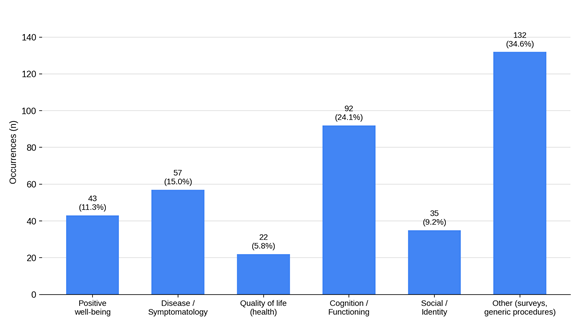
Graphic 2 (visual version). Distribution of instruments by conceptual domain.
Source: Elaborated by the authors.