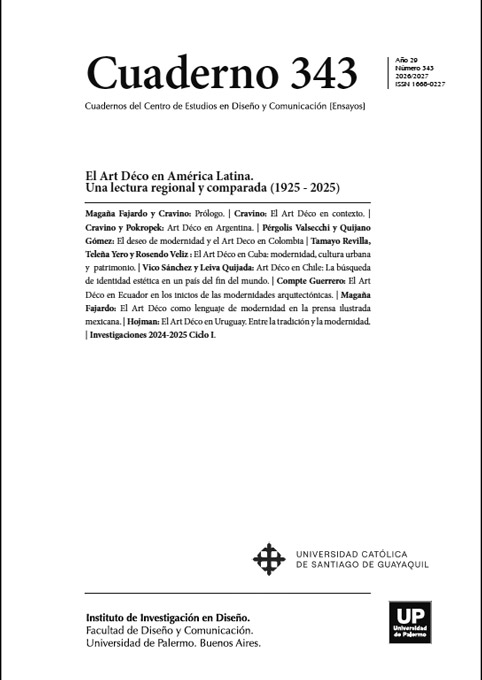
El Art Déco en Cuba: Modernidad, Cultura Urbana y Patrimonio
Abstract
Art Déco arrived in Cuba between 1927 and 1945, almost simultaneously with its emergence in Europe and the United States. It was driven by economic growth and the introduction of reinforced concrete, which enabled new architectural forms. The style represented a transition between eclecticism and the Modern Movement, characterized by a geometric and functional language. Its most visible features included verticality, volumetric setbacks, and stylized ornamentation.
References
Besel, K., & Pico, J. R. (2017). Historical Preservation in Havana: Planning for the Next Generation of NGO Leaders. International Journal of Cuban Studies / Pluto Journals, 9(2), 225-234. https://www.jstor.org/stable/10.13169/intejcubastud.9.2.0225
Cabrales Muñoz, N. (2010). Presencia del anillo articulador en los planes directores para Santiago de Cuba. Ciencia en su PC, (1), 77–88. Centro de Información y Gestión Tecnológica de Santiago de Cuba. http://www.redalyc.org/articulo.oa?id=181317867008
Coyula, M., Uggen, J. F., & Angotti, T. (1996). The Neighborhood as Workshop. Latin American Perspectives, 23( 4), The «Urban Question» in Latin America), 90-103. http://www.jstor.org/stable/2634131
Los autores/as que publiquen en esta revista ceden los derechos de autor y de publicación a "Cuadernos del Centro de Estudios de Diseño y Comunicación", Aceptando el registro de su trabajo bajo una licencia de atribución de Creative Commons, que permite a terceros utilizar lo publicado siempre que de el crédito pertinente a los autores y a esta revista.